In the evolving landscape of corporate governance, the internal audit function is no longer just a compliance requirement—it is a strategic value-driver. However, to maintain this status, audit teams must themselves be audited. This is where the External Quality Assessment (EQA) comes into play.
1.What is an External Quality Assessment (EQA)?
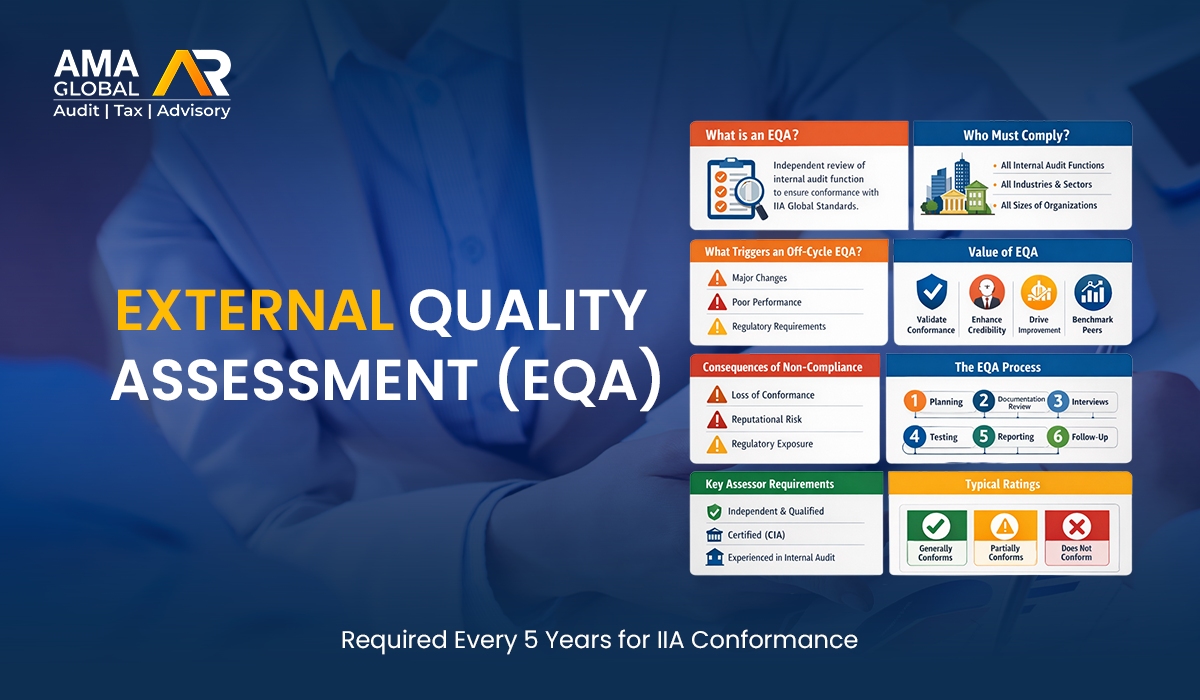
An EQA is an independent, comprehensive review of an internal audit function conducted by a qualified external assessor or assessment team.
Think of the EQA as an “audit of the audit function”—an independent mirror that reflects how well your internal audit team is performing against the highest global professional standards. It evaluates conformance with the Institute of Internal Auditors (IIA) Global Internal Audit Standards, covering essential pillars like purpose, ethics, governance, management, and performance.
2. Who is Required to Comply?
The requirement for an EQA applies universally, regardless of organization size, sector, or geography. Specifically, it is mandatory for:
- Every internal audit function (in-house, outsourced, or co-sourced).
- All industries (Private, public, financial services, healthcare, government, and non-profits).
- Functions of any size (From one-person teams to large global departments).
The 5-Year Rule: Standard 8.4 of the 2024 Global Internal Audit Standards explicitly requires that an EQA (or a Self-Assessment with Independent Validation — SAIV) be completed at least once every five years.
3. What Triggers an “Off-Cycle” EQA?
While the five-year cycle is the standard, certain triggers may require a review more frequently:
- Leadership Changes: New leadership or significant restructuring within the audit function.
- Performance Concerns: Poor results or quality issues identified via internal assessments.
- Regulatory Mandates: Contractual or legal obligations requiring more frequent independent reviews.
4. The Value Addition: Why Invest in an EQA?
An EQA isn’t just about “checking a box.” It offers multi-dimensional benefits to the organization:
- Validate Conformance: Ensure you are meeting rigorous professional standards.
- Enhance Credibility: Build stakeholder and Board confidence in audit findings.
- Benchmark Performance: See how you stack up against industry peers.
- Strengthen Oversight: Provide the Board with independent assurance of audit quality.
- Drive Improvement: Identify specific areas for talent and cultural reinforcement.
5. The Risks of Non-Compliance
While the IIA does not impose direct financial fines, the consequences of skipping an EQA are severe:
- Loss of Conformance Status: You can no longer claim to operate under IIA Standards.
- Reputational Risk: Eroded credibility with stakeholders and regulators.
- Governance Gaps: Hidden failures in the audit process that lead to missed organizational risks.
6. How the EQA Process Works
The EQA follows a structured, six-phase approach to provide a holistic evaluation:
- Planning and Scoping: Defining the boundaries of the review.
- Documentation Review: Analyzing manuals, work papers, and charters.
- Interviews and Surveys: Gathering feedback from the Board, management, and audit staff.
- Fieldwork and Testing: Evidence-based evaluation of audit execution.
- Reporting: Issuing a conformance rating (Generally Conforms, Partially Conforms, or Does Not Conform).
- Action Planning: Establishing a roadmap for improvement.
7. Key Qualification Requirements for Assessors
To ensure a valid EQA, the assessor must meet strict criteria:
- Independence: No conflicts of interest, in fact or appearance.
- Certified Expertise: At least one team member must hold an active CIA (Certified Internal Auditor) designation.
- Senior Leadership Experience: Assessors should have experience as a CAE or senior audit leader.
- No Reciprocity: “Peer-to-peer” assessments between two organizations are not considered independent.
Common FAQs about EQA
Can a small organization or a one-person internal audit function skip the EQA?
No. The EQA requirement applies to every internal audit function regardless of size. Whether you are a sole internal auditor or part of a large team, if you claim conformance with the IIA Standards, an EQA is mandatory.
How long does an EQA typically take?
The duration depends on the size of the internal audit function, the number of locations, and the volume of audit reports produced annually.
What rating can an internal audit function receive from an EQA?
There are three possible conformance ratings. Generally Conforms is the highest rating, indicating that policies, procedures, and practices are in place to meet the Standards.Partially Conforms indicates deficiencies in some areas that require attention. Does Not Conform signals significant gaps that need immediate remediation.
Who can conduct an EQA?
The assessor must be qualified, independent, and free from conflicts of interest. At least one team member must hold an active CIA certification.
How AMA delivers EQA Services
At AMA Global , we bring a unique combination of technical rigour, professional credentials, and deep UAE market knowledge to every External Quality Assessment engagement. Our team of qualified CA, CIA and CFE professionals has extensive experience across multiple sectors — including trading, manufacturing, financial services, and government-linked entities — enabling us to benchmark your internal audit function not just against the IIA Standards, but against regional best practices.
Our EQA Service Offerings
- Full External Quality Assessment (EQA) — comprehensive evaluation across all five IIA Domains
- Self-Assessment with Independent Validation (SAIV) — supporting the CAE in performing a structured self-assessment, followed by independent validation
- Readiness / Gap Assessment — a preparatory review to identify conformance gaps before a formal EQA, enabling targeted improvement
- Post-EQA Action Plan Support — assisting internal audit teams in implementing EQA recommendations and tracking progress
Whether you are preparing for your first EQA or refreshing after a five-year cycle, AMA is your trusted partner for independent, professional, and value-driven quality assessment services in the UAE and beyond.
To learn more about our EQA services or to request a proposal, please contact us at AMA Global Audit & Tax Advisory

Monish Mohan is a versatile and accomplished Auditor, VAT Consultant, Finance and Accounts Professional offering over 18 years of experience in UAE VAT, Audit & Assurance, Finance management Advisory & Accounting & bookkeeping.