————————————————————————————————————–
As the UAE advances toward mandatory e-invoicing, businesses are increasingly turning to Accredited Service Providers (ASPs) to ensure compliance and streamline operations. Many organizations naturally rely on ASP solutions bundled with their ERP systems, assuming this will cover all regulatory and operational requirements.
However, this approach—while convenient in the short term—can introduce significant long-term risks if not carefully evaluated.
The Dependency Trap of ERP-Linked ASPs
ERP-integrated ASP solutions often promise simplicity: one system, one vendor, and minimal integration effort. But this convenience can quickly turn into a dependency.
As your business evolves, upgrading or replacing your ERP becomes inevitable. If your ASP is tightly bound to your current ERP, it may not support integration with new systems. This creates a situation where your compliance framework is effectively locked to outdated technology.
Instead of enabling progress, your ASP becomes a barrier to transformation.
When a Past Decision Costs Your Future
Businesses are not static. As operations grow, diversify, or expand geographically, the need to upgrade or change ERP systems becomes inevitable. However, when your ASP is deeply embedded within your existing ERP ecosystem, it often lacks the flexibility to integrate with new systems.
This does not just create a compliance bottleneck—it can directly limit your business’s exponential growth potential. A tightly coupled ASP restricts your ability to scale, adopt new technologies, enter new markets, or restructure operations efficiently. What may have seemed like a convenient decision in the past can evolve into a structural constraint, slowing down innovation and limiting strategic opportunities.
The Overlooked Challenge: Customized ERPs
Many businesses in the UAE operate on customized or in-house ERP systems tailored to their specific processes. While these systems offer operational flexibility, they introduce additional complexity when integrating with ASPs.
Not all ASP providers are equipped to handle customized ERP environments. Some may require significant adjustments, while others may not support such integrations at all.
In these situations, businesses are often encouraged—directly or indirectly—to migrate to a specific ERP system recommended by the ASP.
This is a critical red flag.
If your ASP is insisting on moving you to a particular ERP, it may not be about making your business compliance-ready. More often, it reflects the ASP’s own limitations in handling diverse or complex integrations.
When Advice Is Driven by Convenience, Not Strategy
Similarly, ERP vendors offering bundled ASP solutions may promote their ecosystem as the most “efficient” path. While this may simplify integration for them, it does not necessarily align with your long-term business strategy.
Decisions around ERP and ASP selection should never be driven by vendor convenience.
They should be driven by your business goals, scalability needs, and regulatory roadmap.
Growth, Multi-ERP Environments, and Global Expansion
As organizations scale, they often adopt multiple ERP systems across entities, regions, or business lines. In such cases, an ERP-dependent ASP creates fragmentation, limiting visibility and control.
Additionally, with the anticipated inclusion of B2C transactions in UAE e-invoicing, transaction volumes will increase significantly. At the same time, global adoption of e-invoicing frameworks continues to accelerate.
An ASP that cannot operate across systems and jurisdictions will struggle to support this level of complexity.
Integration vs Interoperability
It’s important to distinguish between integration and interoperability.
- Integration means connecting your ASP to a specific ERP system.
- Interoperability means your ASP can seamlessly work across multiple systems, platforms, and regulatory environments.
While most providers focus on integration, true business resilience lies in interoperability.
An interoperable ASP ensures:
- Flexibility to switch or upgrade ERP systems without disruption
- Ability to manage multiple ERPs under one unified framework
- Scalability to handle B2B and future B2C requirements
- Readiness for cross-border e-invoicing compliance
Future-ready businesses prioritize interoperability because it preserves flexibility and supports growth without disruption.
A Leadership-Level Decision, Not a Vendor-Led One
Choosing an ASP is not just an IT decision—it is a strategic business decision.
Whether you are a CEO, CFO, or CTO, the responsibility sits with you to ensure that your organization’s e-invoicing framework supports long-term objectives.
Do not delegate this decision entirely to:
- Your ASP, who may be working within their technical limitations
- Your ERP vendor, who may be prioritizing ecosystem retention
You must evaluate whether the solution empowers your business—or restricts it.
A Practical Checkpoint Before Selecting an ASP
Here’s a sharper, leadership-focused version of that section with a practical checklist that directly speaks to decision-makers; This is not just a technical checklist. It is a leadership checkpoint.
Ask yourself:
- Are we adopting an ASP strategy driven by our business vision, or are we following a vendor-led approach?
- Do we, as decision-makers, have full visibility over how the ASP integrates across our systems—including customized ERPs?
- Is the recommendation to use a specific ERP coming from our internal strategy, or from the ASP’s integration limitations?
- If we decide to change or upgrade our ERP tomorrow, will our ASP enable that move—or resist it?
- Can this ASP support multiple ERP environments across entities, regions, or future expansions?
- Are we prepared for upcoming UAE B2C e-invoicing and increased transaction volumes?
- Does this solution position us for global e-invoicing compliance as we expand beyond the UAE?
- Are we building a scalable digital infrastructure—or locking ourselves into a short-term convenience?
At a leadership level—whether CEO, CFO, or CTO—this decision must remain within your control.
Vendors should align with your strategy, not define it.
Interoperability Beyond Integration
At AMA Global, we believe e-invoicing is not just about compliance—it is about building a resilient and future-ready digital foundation.
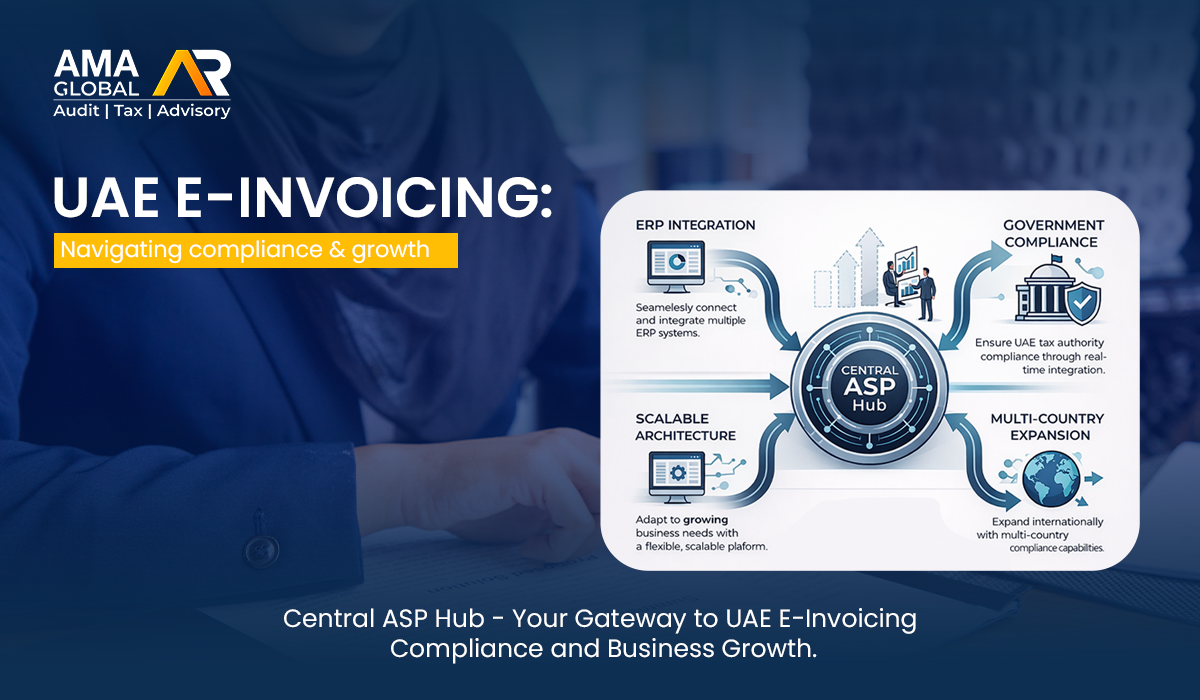
We focus on interoperability beyond basic integration. Our solutions are designed to work across multiple ERP systems, including customized environments, ensuring your business remains agile and scalable.
We enable:
- Seamless multi-ERP integration
- Support for customized ERP ecosystems
- Readiness for UAE B2B and future B2C requirements
- Scalability for global e-invoicing frameworks
- Centralized control and enhanced operational visibility
We don’t align you to our limitations—we align our solutions to your business.
Take Control of Your E-Invoicing Strategy
Your ASP should empower your growth, not restrict it. The right decision today can define your operational flexibility for years to come.
If you are evaluating ASP options or want a future-ready approach tailored to your business, AMA Global is here to support you.
Frequently Asked Questions (FAQs)
What is an ASP in UAE e-invoicing?
An Accredited Service Provider (ASP) is an authorized entity that helps businesses generate, validate, and transmit e-invoices in compliance with UAE regulations. It acts as the bridge between your ERP system and the government platform.
Is it safe to use an ASP provided by my ERP vendor?
It can be convenient, but not always strategic. ERP-linked ASPs are often tightly integrated, which may limit flexibility if you upgrade systems, adopt multiple ERPs, or expand operations. It’s important to assess long-term scalability, not just immediate ease.
What is the risk of choosing the wrong ASP?
A poorly chosen ASP can restrict ERP migration, limit integration with customized systems, increase operational complexity, and ultimately slow down your business growth—not just compliance readiness.
Can an ASP support customized ERP systems?
Not all ASPs can. Businesses using customized or in-house ERPs should ensure the ASP has strong interoperability capabilities and experience handling non-standard integrations.
What does interoperability mean in e-invoicing?
Interoperability means the ASP can seamlessly integrate with multiple ERP systems, adapt to different business environments, and support various regulatory frameworks—locally and globally.
Why is interoperability more important than integration?
Integration connects to one system; interoperability supports many. As businesses grow and evolve, interoperability ensures flexibility, scalability, and freedom from vendor lock-in.
Will UAE e-invoicing include B2C transactions?
Yes, B2C transactions are expected to be included in future phases. This will significantly increase invoice volumes and require more scalable and robust ASP solutions.
How does e-invoicing impact businesses operating in multiple countries?
Different countries have different e-invoicing requirements. A capable ASP should support multi-country compliance, helping businesses manage diverse regulatory frameworks efficiently.
What are the key red flags when selecting an ASP?
Common red flags include forcing you to adopt a specific ERP, inability to support multiple systems, lack of support for customized ERPs, and limited readiness for future regulatory changes.
Who should take the final decision on ASP selection?
The decision should be led by business leadership—CEO, CFO, or CTO—not driven solely by ASP providers or ERP vendors. It must align with your long-term strategy, not vendor limitations.
How can AMA Global support my e-invoicing journey?
AMA Global offers interoperable ASP solutions designed to work across multiple ERP systems, including customized environments. The focus is on scalability, flexibility, and ensuring your business remains future-ready beyond compliance.

Monish Mohan is a versatile and accomplished Auditor, VAT Consultant, Finance and Accounts Professional offering over 18 years of experience in UAE VAT, Audit & Assurance, Finance management Advisory & Accounting & bookkeeping.